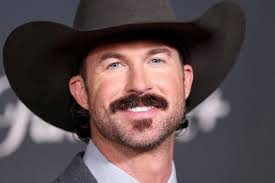
There are stories that don’t just celebrate success—they trace the long, uneven road behind it. Riley Green’s return to Jacksonville State University belongs to that category, where achievement is not a sudden arrival but the result of years of quiet persistence, shifting dreams, and choices made when certainty was nowhere in sight.
Standing at the Spring Commencement on April 30, the 37-year-old artist received an honorary Doctor of Letters from the same institution where he once walked on as a quarterback between 2007 and 2009. The moment carried more weight than ceremony alone; it reflected a full-circle journey that began long before the spotlight ever found him.
Before the awards and recognition, there was distance—between ambition and reality, between potential and opportunity. After college, Green stepped away from football and entered the world of construction, a space far removed from stages and microphones. Yet even in that season, the idea of music never fully disappeared; it simply waited for its turn.

Nashville eventually became that turning point. It was not an immediate breakthrough but a gradual unfolding of direction. Like many artists who arrive after detours, his path was marked by uncertainty, small openings, and the steady decision to keep moving forward when results were not guaranteed.
Today, his name is attached to ACM Awards, chart-topping songs, and a growing presence in entertainment, including a starring role in CBS’s Marshals. But what makes his story resonate is not the visibility of success—it is the contrast between where he started and what he chose to pursue when stability would have been easier.
The return to JSU was not just ceremonial; it was reflective. Alumni often revisit campuses as symbols of achievement, but this moment felt more like acknowledgment of endurance. The same fields where he once trained now stood as the backdrop to a narrative that had expanded far beyond athletics.
During his keynote address, Green offered graduates a line that distilled his journey into something simple yet forceful: “Grab the heavy end. Whatever you find that you’re good at, don’t let it get away. Chase it.” It wasn’t framed as perfection, but as action—an encouragement to recognize effort over hesitation.
There is a particular honesty in advice shaped by lived detours. It does not romanticize timing or guarantee outcomes. Instead, it emphasizes awareness—the ability to notice what feels right and commit to it even when the path ahead is unclear or inconvenient.
His message also carries an unspoken truth about identity. Many people begin in one direction, only to discover that life redirects them elsewhere. What matters is not the original plan, but the willingness to respond when passion begins to surface in unexpected places.
For the graduates listening, the words landed in a moment of transition—the space between structured education and uncertain beginnings. In that space, encouragement becomes more than inspiration; it becomes permission to take risks without waiting for perfect conditions.

Riley Green’s story does not position success as destiny. Instead, it frames it as accumulation: years of effort, shifts in direction, and persistence through work that did not yet resemble the dream. That accumulation is what turned a walk-on athlete into a recognized artist standing at a podium.
What makes the narrative powerful is not the destination itself, but the reminder embedded within it—that careers are rarely linear, and purpose often reveals itself only after patience and movement collide. The heavy end he speaks of is not just opportunity, but recognition of one’s own direction before it slips away.
And as his words lingered over the graduating class, one question remained quietly suspended in the air: what happens when you finally decide to grab yours?