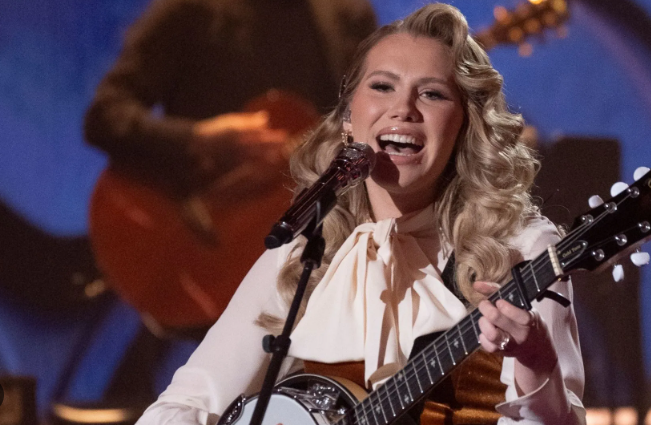
There are performances that entertain, and then there are moments that quietly rewrite a story in real time. On “Taylor Swift Night,” something shifted—not just on stage, but in the way the audience understood transformation. Hannah Harper didn’t walk out as a contestant hoping to impress. She stepped into the light as someone ready to reveal who she had become.

And that difference was everything.
From the very first note of “Mean,” originally made famous by Taylor Swift, it was clear this would not be a familiar retelling. Hannah didn’t lean on the song’s playful defiance. Instead, she stripped it down to its emotional core, turning it into something quieter, heavier, and undeniably personal. It no longer felt like a response to critics—it felt like a reflection of lived experience.
That’s where the transformation began.
There was a restraint in her delivery that felt intentional, almost surgical. She didn’t over-sing. She didn’t rush to impress. Every word carried weight, as if she understood that the power of the moment wasn’t in how big she could go, but in how honest she could be. And in that honesty, the song found a new identity.
It wasn’t a cover anymore.
It became a conversation.
As the performance unfolded, the room seemed to hold its breath. The usual noise of competition—the anticipation, the comparison, the pressure—faded into the background. What remained was something far more rare: stillness. The kind of silence that signals not boredom, but complete attention.
Even Carrie Underwood appeared visibly caught in that moment. Her reaction wasn’t exaggerated or staged. It was instinctive. A recognition of control, emotion, and confidence coming together in a way that can’t be manufactured. When someone like her pauses, you know something real just happened.
Because she’s seen it before.
And she knows how rare it is.
What makes this performance even more compelling is the journey behind it. Hannah Harper didn’t arrive on American Idol as a fully formed artist. Her story—rooted in everyday life, in motherhood, in quiet resilience—didn’t scream for attention. It grew slowly, round by round, performance by performance.
And then, suddenly, it spoke.
This wasn’t just a technical leap. It was an emotional one. The kind of shift where an artist stops asking for approval and starts owning their space. Where the stage no longer feels like borrowed ground, but something earned through vulnerability and persistence.
That’s the moment audiences recognize.

Not perfection—but truth.
Hannah’s version of “Mean” didn’t rely on reinvention for the sake of surprise. It worked because it felt necessary. As though this was the only way she could tell that story now, at this point in her life, with everything she’s learned and carried. That authenticity doesn’t just resonate—it lingers.
Long after the music ends.
In a competition built on weekly highlights, that kind of impact is rare. Most performances are remembered for a moment. This one will be remembered for what it meant. For how it made people feel seen, understood, and quietly moved.
That’s not just good television.
That’s artistry.
And now, the conversation changes.
Because when an artist reaches this point—when they stop performing and start revealing—the question is no longer whether they can win. It becomes whether the competition can truly contain what they’ve become. Hannah Harper didn’t just deliver a standout performance.
She delivered a turning point.
The kind that doesn’t announce itself loudly, but echoes in everything that follows.
And if that moment was any indication, the story unfolding on that stage isn’t just about finding a winner.
It’s about witnessing the arrival of someone who was always meant to be more.