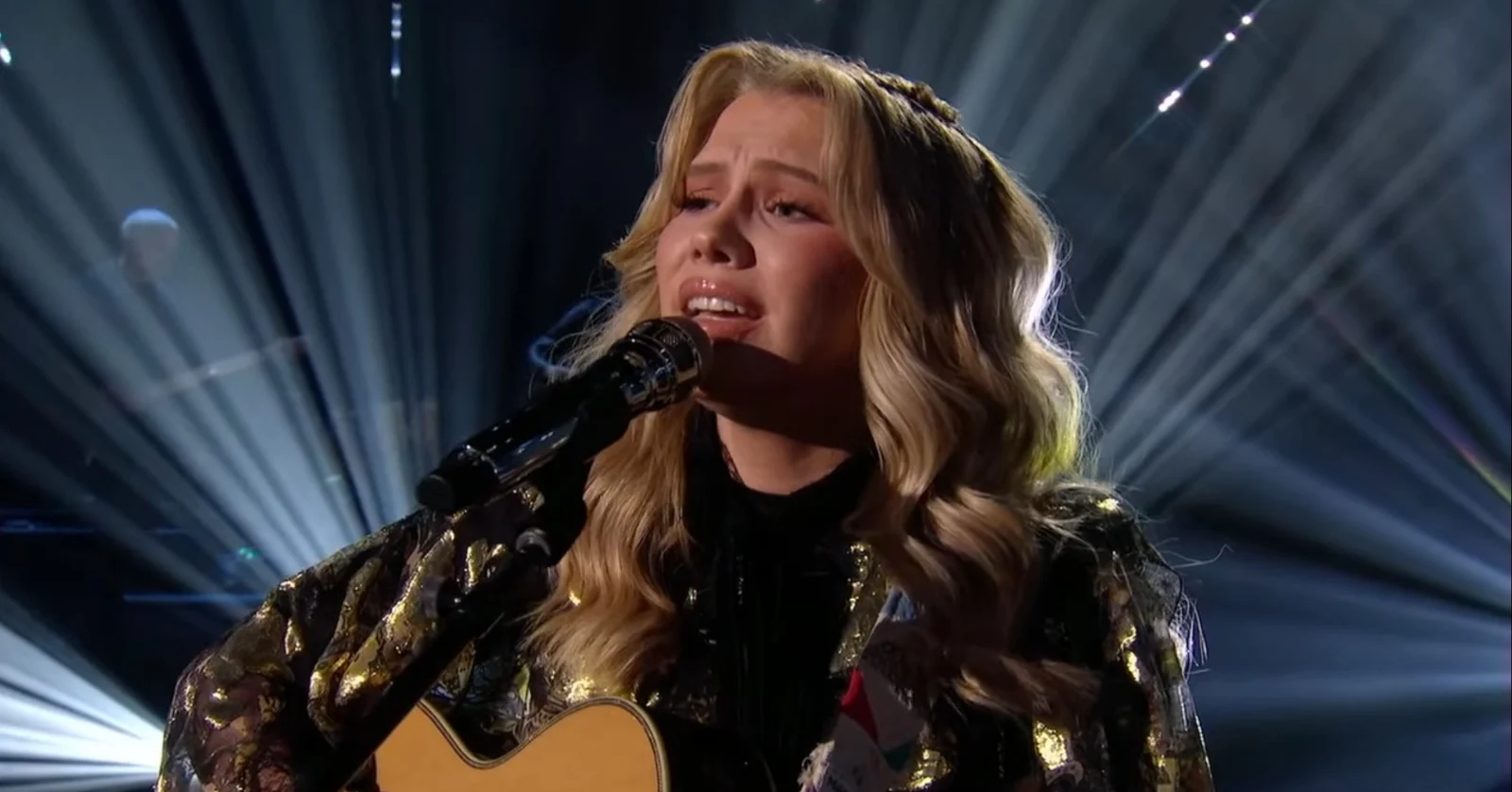
There are performances that entertain for a few minutes and disappear by the next commercial break. Then there are performances that alter the atmosphere of an entire room—moments so emotionally charged that people forget they are watching a television competition at all. Hannah Harper’s haunting rendition of “Landslide” on Rock & Roll Hall of Fame Night felt like the second kind.
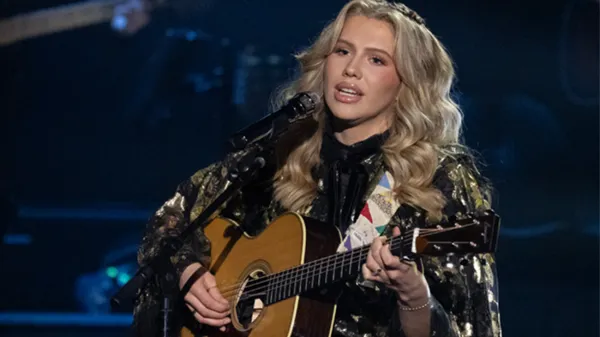
From the opening lines, something in the studio changed.
The usual anticipation that fills American Idol gave way to a strange stillness. Contestants often arrive on theme nights trying to out-sing one another with vocal fireworks and oversized moments. Hannah took the opposite path. She entered softly, almost cautiously, allowing the song to breathe before slowly drawing everyone into it.
That decision proved powerful immediately.
Her voice carried a trembling honesty that made the lyrics feel less like performance and more like confession. It was not weakness in the tone—it was vulnerability. Every slight crackle, every delicate pause, every controlled breath gave the impression that the song was being lived in real time rather than repeated from rehearsal.
Then came the note everyone is talking about.
Some moments on stage are loud enough to trigger instant applause. This one did something rarer. When Hannah reached that suspended, aching note, the room went completely silent. Not polite silence. Not waiting silence. The kind of silence that happens when people are suddenly aware they are witnessing something too intimate to interrupt.
As many viewers later said, you could have heard a pin drop.
The cameras caught reactions that only deepened the feeling. Carrie Underwood, usually poised and composed, looked visibly shaken. Her eyes glistened as she pressed a hand to her face, trying to steady herself while still listening. It was not the reaction of a judge searching for comments. It was the reaction of someone unexpectedly moved by art.
Luke Bryan’s response added even more mystery.
He leaned forward and whispered something under his breath, and whatever he said seemed to ripple through the panel. The energy shifted instantly. Faces changed. Body language changed. It was as though the judges collectively realized this had become bigger than a standard critique segment.
That is what made the moment unforgettable.
The judges no longer looked like judges. They looked like people remembering something personal. Music has that power when it is delivered honestly enough—it can awaken memories no one planned to revisit. Hannah Harper seemed to tap into that invisible place where songs stop being entertainment and start becoming mirrors.
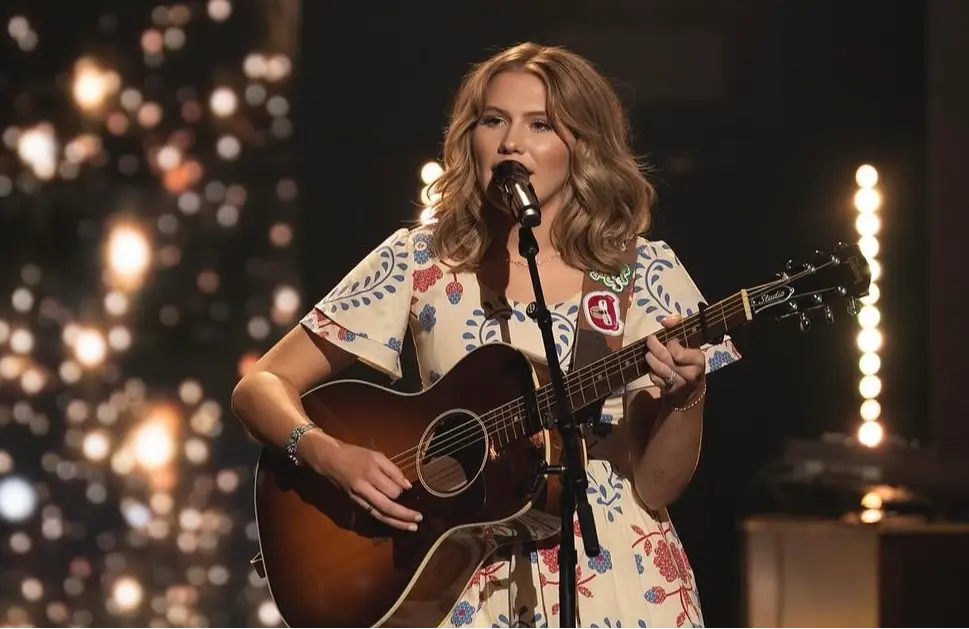
Her choice of “Landslide” was no small risk.
It is one of those songs audiences carry with them long before a contestant sings the first line. It belongs to heartbreak, change, aging, reflection, and quiet courage. Many artists attempt it and disappear beneath the weight of its legacy. Hannah did something more difficult: she found herself inside it.
She did not imitate the original spirit.
She honored it while revealing her own.
That balance is often what separates a talented contestant from a true artist. Hannah never sounded like she was trying to prove she could sing the song. She sounded like she needed to sing it. Viewers can feel the difference immediately.
By the final verse, the entire studio seemed emotionally suspended.
No one fidgeted. No one glanced around. Even the applause, when it finally arrived, felt delayed by necessity—as though people needed a moment to return to the room before responding. That kind of reaction cannot be coached or edited into existence. It happens only when a performance genuinely reaches people.
Unsurprisingly, fans online responded with intensity.
Within minutes, social media was flooded with clips, reactions, and declarations that Hannah Harper had secured her place among the season’s elite. Many called her a “Top 3 lock.” Others went further, saying the performance felt like a finale moment delivered weeks early. Whether those predictions hold or not, one truth was obvious: audiences now see her differently.
She is no longer just a contestant with promise.
She is now a contestant with momentum.
And momentum on shows like American Idol can be everything. It is built when viewers stop casually watching and start emotionally investing. Hannah’s “Landslide” appeared to create that exact shift. People were no longer evaluating her potential—they were imagining how far she could go.
Then came the whispers of something else.
According to murmurs circulating among fans and production watchers, an unseen moment after the cameras stopped rolling may have changed everything further. No official details emerged. No one on stage confirmed anything publicly. But the speculation alone added another layer to an already unforgettable night.
Did one of the judges say something privately?
Did Carrie Underwood approach Hannah backstage?
Did producers recognize, in real time, that a defining star moment had just occurred?
No one seems willing to say.
And perhaps that mystery only strengthens the performance itself. Some moments do not need explanation. They are felt more than understood. Trying to reduce them to backstage details can miss the point entirely.
What happened on that stage was enough.
Hannah Harper stood under bright lights, chose vulnerability over spectacle, and reminded millions that the strongest performances are not always the loudest ones. Sometimes they arrive in a trembling voice, wrapped in honesty, and leave an entire room too moved to speak.
That is what happened when she sang “Landslide.”
Not just applause. Not just praise.
Silence first.
And sometimes silence is the highest compliment a room can give.