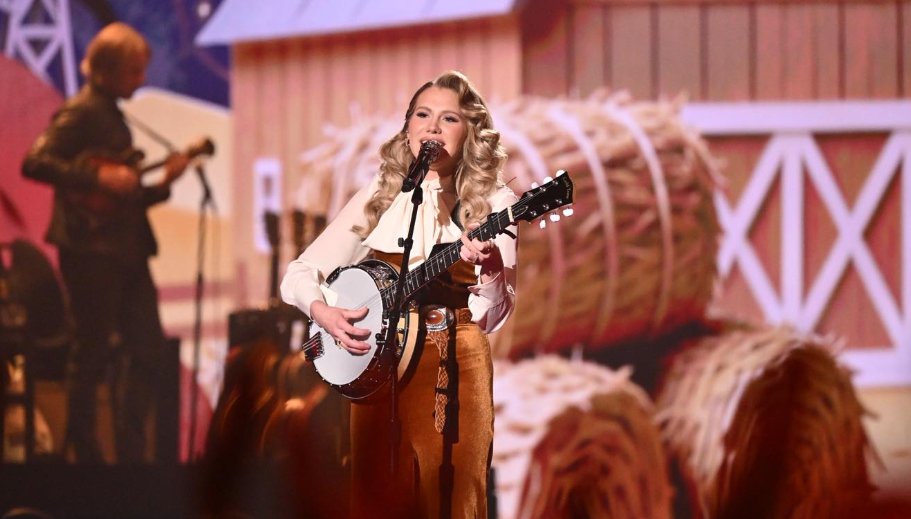
There are performances that entertain, and then there are performances that shift perception. On American Idol, those moments are rare—but when they happen, they change everything. For Hannah Harper, that moment arrived the second she walked on stage with a banjo in hand.
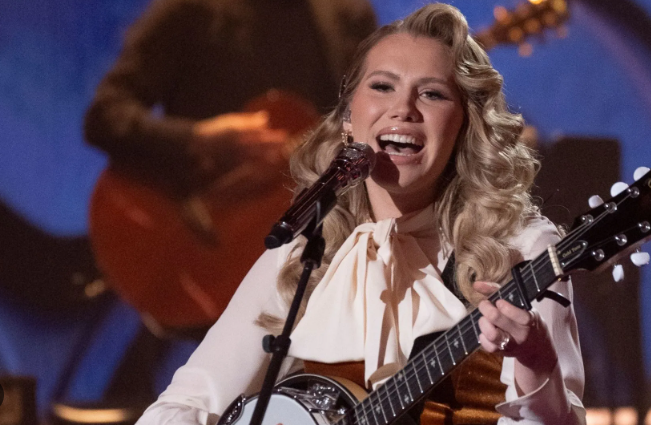
From the very first note of “Mean,” it was clear this wasn’t going to be a standard rendition. Hannah didn’t just perform the song—she reimagined it. By stripping it down and rebuilding it through her country roots, she created something that felt both familiar and entirely new.
That decision wasn’t just creative—it was strategic. In a competition where standing out becomes harder with every round, subtle reinvention can be more powerful than dramatic change. Hannah understood that. Instead of chasing spectacle, she leaned into identity. And in doing so, she gave the audience something they hadn’t seen from anyone else.
The banjo wasn’t a prop. It was a statement. It signaled confidence, intention, and a willingness to take ownership of the stage in a way that felt natural rather than forced. That authenticity translated instantly. You could feel it in the room—the shift from passive listening to active connection.
What made the performance resonate so deeply wasn’t just the arrangement, but the control behind it. Hannah knew exactly where to push and where to pull back. She allowed the quieter moments to breathe, trusting that the simplicity would carry weight. And it did.
This is where many contestants struggle. They mistake volume for impact, complexity for depth. Hannah did the opposite. She simplified, clarified, and in doing so, amplified the emotional core of the song. It wasn’t about showing how much she could do—it was about showing how well she understood what needed to be done.

The judges recognized that immediately. One praised her for staying true to herself, a compliment that carries more significance than it might seem. In a competition environment, authenticity can be difficult to maintain under pressure. Hannah not only maintained it—she strengthened it.
Then came Carrie Underwood, whose feedback stood out as some of her strongest for Hannah this season. When a judge of her caliber highlights a performance at this stage, it’s not just encouragement—it’s acknowledgment. It signals that the performance crossed into something more than impressive. It became memorable.
There’s a reason moments like this matter so much in the final stretch. As the competition narrows, the margin between contestants becomes smaller. Everyone is talented. Everyone is capable. What separates them is not just skill, but clarity—clarity of voice, of identity, of purpose.
Hannah’s performance delivered all three. It wasn’t just about proving she could sing. That’s already been established. It was about proving she knows who she is as an artist. And that clarity is what makes her increasingly difficult to compete against.
Another layer to this moment is timing. Many contestants attempt their boldest moves too early or too late. Hannah’s came at exactly the right point—late enough to matter, but early enough to build momentum. It didn’t just earn her praise; it repositioned her within the competition.
Momentum, at this stage, is everything. It’s not just about one performance—it’s about what that performance unlocks. Confidence builds. Audience connection deepens. Perception shifts. And suddenly, a contestant who was already strong becomes something more: inevitable.
Looking ahead, the question isn’t whether Hannah can deliver again. It’s whether anyone else can match the balance she just achieved. Because what she demonstrated wasn’t just talent—it was control. The ability to take a risk, execute it with precision, and make it feel effortless.
That’s what defines winners in this kind of environment. Not perfection, but presence. Not volume, but impact. Not imitation, but identity.
And with a banjo, a bold choice, and a perfectly timed performance, Hannah Harper didn’t just stay in the race—she quietly took control of it.