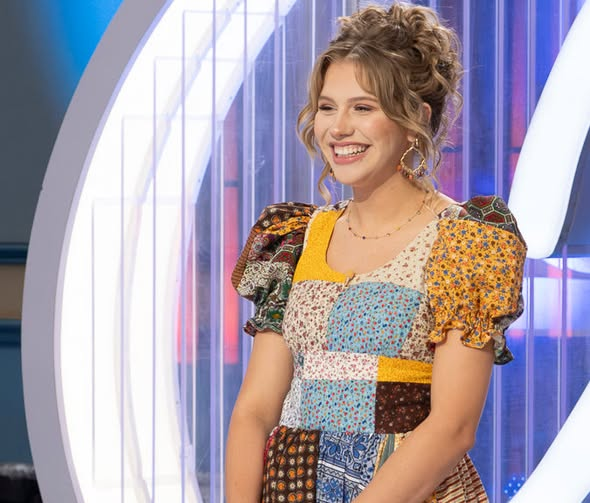
There are voices that entertain, and then there are voices that confess. On the stage of American Idol, Hannah Harper has quietly become the latter. She doesn’t step into the spotlight to impress—she steps into it to release something that feels too heavy to carry alone. And somehow, in that vulnerability, she has created something magnetic.
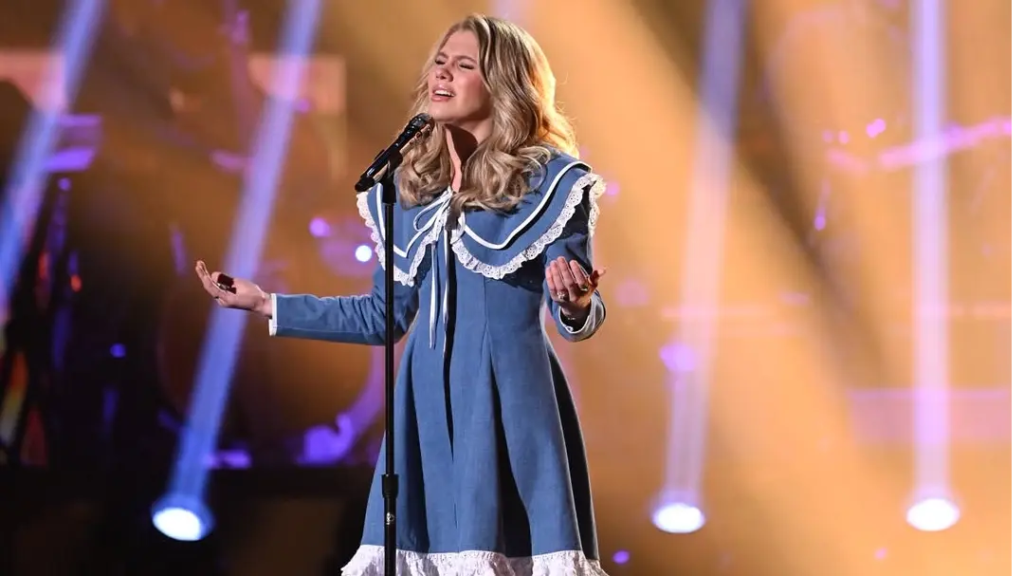
From the very beginning, there was something unpolished about her delivery. Not in technique, but in truth. Her early performances didn’t feel rehearsed—they felt remembered. Like every lyric had already been lived long before it was ever sung. That’s what made people stop. That’s what made people listen.
When “String Cheese” first started circulating, it wasn’t just a viral moment—it was a signal. A signal that authenticity still had power in a world that often rewards perfection over honesty. The song didn’t rely on spectacle. It relied on sincerity, and that sincerity spread faster than any stage production ever could.
But viral moments are fleeting. What matters is what comes after them.
And Hannah didn’t just follow up—she deepened.
With “Bitter Weed,” there was a shift. The fragility was still there, but it had structure now. The emotion didn’t spill—it flowed. You could feel the control, the intention, the understanding of when to hold back and when to let go. It wasn’t just pain anymore. It was storytelling.
That evolution is where things get complicated.
Because growth in a competition like American Idol is both a gift and a risk. The audience falls in love with who you were—but expects you to become something more. Stay the same, and you feel repetitive. Change too much, and you risk losing the very essence that made people care in the first place.

Hannah stands right in the middle of that tension.
And now, the rules of the game have shifted.
This is no longer just about moments that go viral or performances that trend overnight. This is about votes. Real, measurable, unforgiving numbers. Emotion must now translate into action. Connection must turn into commitment. And not everyone who feels something will pick up their phone and vote for it.
That’s the quiet danger.
Because what Hannah does is subtle. It builds slowly. It asks the audience to sit with discomfort, to lean into something real. But voting culture often rewards immediacy—big notes, dramatic peaks, unforgettable hooks that hit instantly. The question is no longer whether she can move people.
It’s whether she can move them fast enough.
Still, there’s something about her trajectory that feels different.
Each performance doesn’t just show improvement—it shows awareness. She’s not just singing better; she’s understanding more. Understanding how to shape a moment, how to guide an audience, how to transform vulnerability into something that feels intentional rather than exposed.
That kind of awareness is rare.
And it’s what separates a contestant from an artist.
If she continues on this path—adding variation, expanding her range, finding new textures within her voice while holding onto the core of her honesty—she doesn’t just have a shot at the Top 14. She has the potential to become one of the defining voices of the season.
But the margin is thin.
Because in a competition driven by public perception, momentum is fragile. It builds quickly, but it can disappear even faster. One performance that feels too familiar. One moment that doesn’t land. One week where the audience feels instead of acts.
And everything can shift.
That’s the reality she’s walking into now.
Not as the underdog anymore. Not as the unexpected breakout. But as someone people are starting to expect something from. And expectation changes everything. It adds weight. It adds pressure. It adds a new kind of silence—the kind that waits to see if you can do it again.
Or if what you gave before was the peak.
Hannah Harper isn’t just competing anymore.
She’s proving that what she carries isn’t temporary.
And the next time she steps onto that stage, it won’t just be about how deeply she can make people feel—
it will be about whether those feelings are strong enough to keep her there.