
There is a certain kind of pressure that doesn’t come from the stage—it comes from expectation. On American Idol, that pressure often shapes contestants into something safer, broader, and more marketable. But for Hannah Harper, the response has been strikingly different. Instead of adjusting, she’s drawing a line.
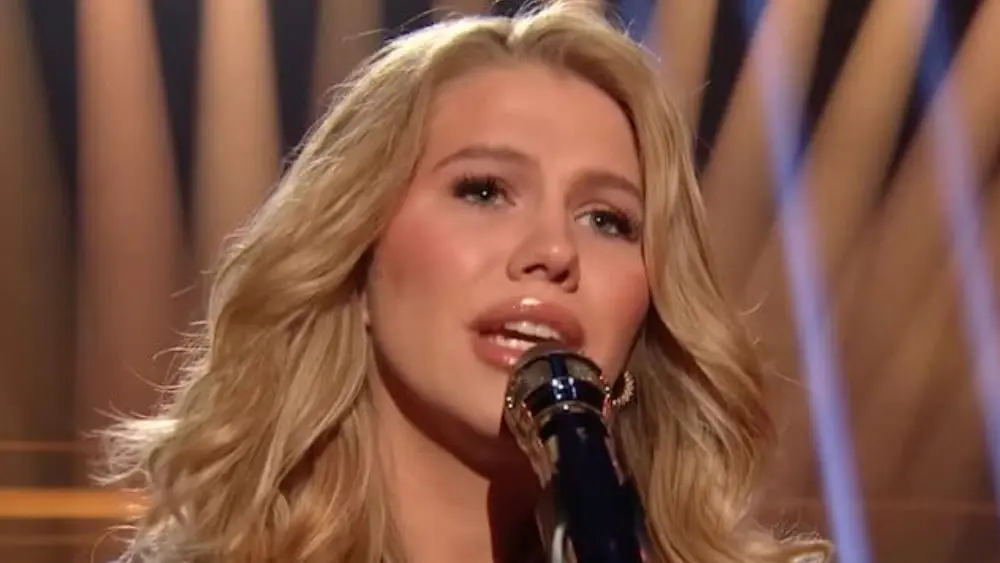
“I will not change.” It’s not just a quote—it’s a decision. And in a competition where flexibility is often praised as growth, choosing not to bend can feel like the boldest move of all. Especially when the criticism is loud, persistent, and aimed directly at the core of who you are as an artist.
The critiques themselves aren’t new. Questions about stage presence. Doubts about whether she fits the mold of a “superstar.” Comments labeling her as “too country” for a platform that thrives on wide appeal. These are the kinds of pressures that have quietly reshaped many contestants before her.
But Hannah didn’t absorb that pressure—she redirected it. Instead of smoothing out her edges, she sharpened them. Instead of stepping away from her country roots, she leaned deeper into them. And that decision didn’t just define her performances—it redefined how the audience sees her.
Take her song choices during major theme nights. On Taylor Swift Night, many contestants pivoted toward polished, radio-ready interpretations. Hannah, however, stayed grounded. She chose a slower, more traditional approach—one that prioritized storytelling over spectacle.
Then came California theme night, another opportunity to shift toward something more contemporary. But once again, she held her ground. The consistency wasn’t accidental. It was intentional. It was a message, delivered not through interviews, but through music.

What makes this approach compelling is that it resists the typical arc of competition shows. Most contestants evolve by expanding outward, adding layers, adapting to different genres. Hannah’s evolution feels different. It’s not about becoming something new—it’s about becoming more of what she already is.
And that distinction changes everything.
Because authenticity, when it’s this clear, creates a different kind of connection. The audience isn’t just watching her perform—they’re watching her choose herself, repeatedly, in a space that constantly invites compromise. That kind of consistency builds trust. And in a voting-based competition, trust is currency.
Of course, there’s risk in that. Refusing to adapt can limit reach. It can alienate viewers who are looking for versatility or broader appeal. It can create the perception that a contestant is one-dimensional. These are real challenges, and they’ve been part of the conversation surrounding Hannah.
But there’s another side to that risk—one that’s becoming increasingly visible.
When an artist commits fully to their identity, they become harder to replicate. They stop competing on versatility and start standing on individuality. And individuality, especially in the final stages of a competition, can be more powerful than range.
There’s also a quiet confidence in her approach. It doesn’t feel defensive. It doesn’t feel like she’s trying to prove critics wrong. It feels like she’s simply uninterested in changing for the sake of approval. That energy translates. It reads as grounded, self-aware, and, most importantly, real.
And real is something audiences recognize immediately.
What’s unfolding now isn’t just a storyline about criticism—it’s a narrative about control. Hannah is taking control of how she’s perceived, how she’s presented, and ultimately, how she’s remembered. She’s not allowing the competition to define her. She’s defining herself within it.
As the finale approaches, this strategy becomes even more significant. Because at this stage, the question isn’t just who can perform the best song—it’s who has the clearest identity moving forward. Who feels like an artist audiences will follow beyond the show.
Hannah’s answer is already clear.
She’s not chasing trends. She’s not reshaping herself to fit expectations. She’s standing in her lane, fully, unapologetically, and consistently. And while that might not satisfy every critic, it creates something far more valuable—a loyal, invested audience that knows exactly who they’re supporting.
In the end, competitions like this aren’t just about winning a title. They’re about establishing a foundation. And sometimes, the strongest foundation isn’t built on flexibility—it’s built on conviction.
“I will not change” might sound like resistance.
But in Hannah Harper’s case, it might be the very thing that sets her apart.