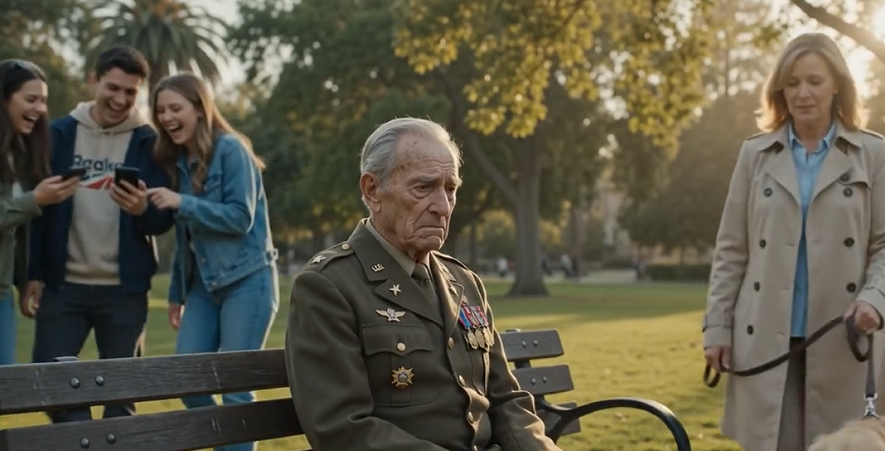
The laughter had already drifted down the walking path, but its sting still lingered in the quiet air. The elderly veteran remained seated on the weathered wooden bench, his hands wrapped tightly around the faded military cap resting on his lap. His medals caught the warm glow of the evening sun, yet they seemed invisible to the people who had mocked them only moments before. Their footsteps faded into the distance, but the silence they left behind felt heavier than the cruel words they had spoken.
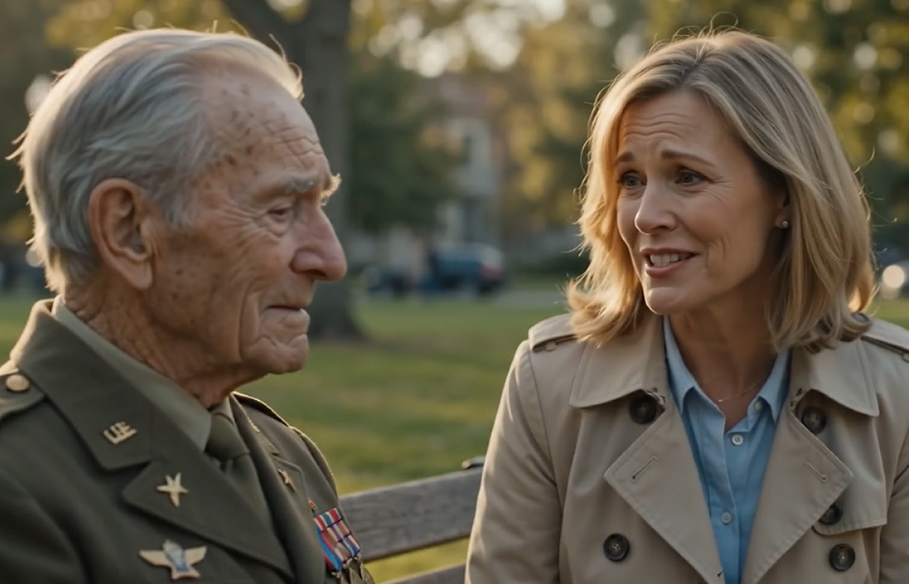
A woman walking her golden retriever slowed as she approached the bench. She had been watching from across the park, unsure whether to intervene earlier. Something about the old man’s posture—the way he stared at the ground instead of the people around him—stopped her in her tracks. As she came closer, her eyes settled on the worn ribbons and medals stitched carefully onto his faded jacket. She didn’t see decorations. She saw a lifetime of sacrifice.
Without hesitation, she guided her dog to sit quietly beside her and looked at the veteran with a gentle smile.
“Thank you for your service,” she said softly.
The words were simple, yet they carried more weight than any speech. The veteran slowly looked up, surprised that someone had noticed him for something other than his worn clothing. A faint smile appeared across his weathered face, though it couldn’t quite erase the sadness resting in his eyes.
“You don’t have to thank me,” he replied quietly.
“But I wanted to,” she answered before taking a seat beside him.
For several peaceful moments, neither of them spoke. Sometimes kindness didn’t need conversation. It simply needed presence. The woman understood that some wounds couldn’t be healed with advice. They could only be eased by reminding someone they weren’t invisible.
Just a few benches away, an elderly man who had been feeding pigeons suddenly stood still. He had overheard the brief exchange and couldn’t take his eyes off the veteran’s face. He slowly approached, his expression shifting from curiosity to disbelief.
“…Michael?” he whispered.
The veteran blinked before looking up.
“Frank?”
The two men stared at each other for a long moment before embracing with trembling arms. Decades disappeared in a heartbeat. Around them, the park seemed to pause.
“I thought I’d never see you again,” Frank said, his voice breaking.
The woman watched quietly as tears welled in both men’s eyes.
“You still kept the medals,” Frank smiled.
“I never wore them for attention,” Michael replied. “Just to remember the people who couldn’t.”
Those words alone silenced everyone close enough to hear them.
Frank turned toward the small group of curious bystanders who had begun gathering nearby.
“You see this man?” he asked.
“I served beside him over forty years ago.”
The crowd grew still.
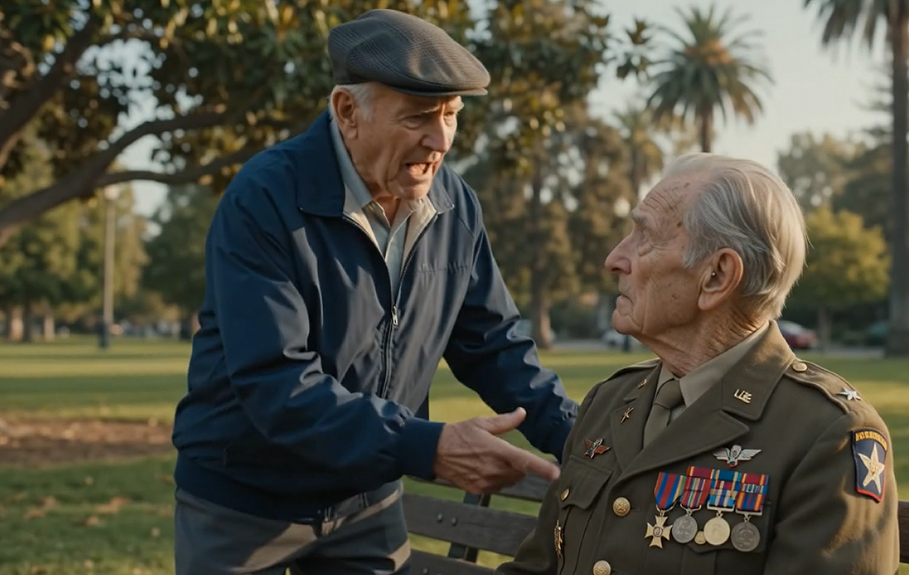
“When our convoy was ambushed overseas, everyone panicked. Bullets were everywhere. Smoke covered everything. I was trapped inside a burning vehicle. I remember thinking that was the end.”
Frank paused, taking a slow breath before continuing.
“But Michael came back.”
The veteran lowered his head, uncomfortable being the center of attention.
“He could have escaped with everyone else. Instead, he ran straight into the fire. Not once. Three times.”
Several people exchanged stunned glances.
“He carried me out first. Then another soldier. Then he went back again because someone else was still calling for help.”
Frank’s voice shook as memories flooded back.
“He saved three lives that day.”
No one interrupted him.
“One of those lives was mine.”
The park had become completely silent.
Parents stopped pushing strollers. Joggers removed their headphones. Children paused their games. Even strangers walking their dogs stood quietly along the path, listening to a story they never expected to hear during an ordinary evening stroll.
Michael gently shook his head.
“We all did what we had to do.”
Frank smiled sadly.
“No, my friend. Most people survive history.”
“You helped write it.”
The woman sitting beside the veteran wiped away a tear.
It wasn’t just the bravery that moved everyone.
It was the humility.
Here sat a man who had carried unimaginable memories for decades without demanding recognition, applause, or gratitude. He had quietly accepted ridicule from strangers who knew nothing about the life he had lived. He had never defended himself because he believed his service was never about proving anything.
Far down the pathway, the same group of young adults noticed the unusual crowd surrounding the bench.
Curious, they wandered back.
At first, they laughed, assuming someone was performing music or telling jokes.
Then they heard Frank’s words.
“…he carried wounded soldiers through gunfire…”
“…he never left anyone behind…”
“…he saved my life…”
The smiles slowly disappeared from their faces.
One of them glanced down at the phone still holding the video they had recorded only minutes earlier.
The recording suddenly felt unbearable.
It no longer looked funny.
It looked cruel.
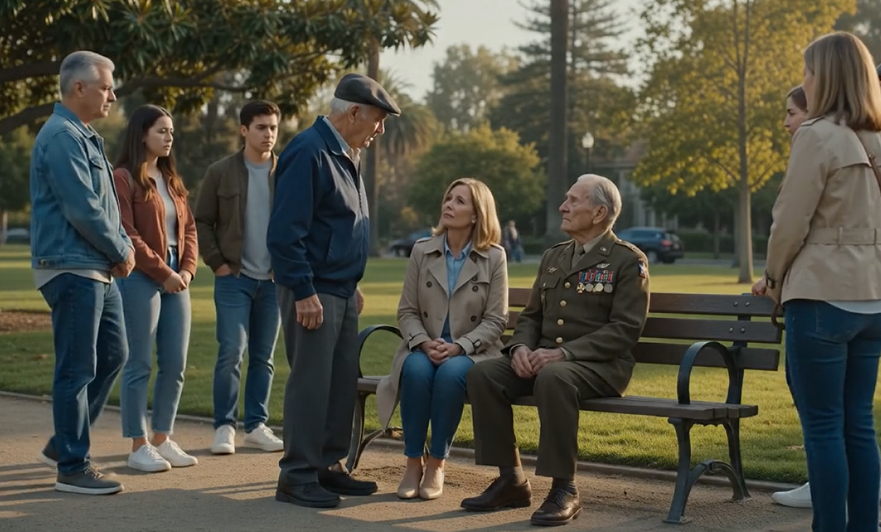
The young man who had filmed everything quietly locked his phone and slipped it into his pocket. None of his friends spoke. The confidence they had carried earlier had vanished, replaced by something unfamiliar.
Shame.
For the first time, they weren’t looking at an old man sitting alone on a bench.
They were looking at someone whose greatest achievements had never been posted online, never chased likes, and never demanded attention.
One of the young women whispered, “We judged him without knowing a single thing.”
No one disagreed.
Finally, the young man stepped forward, stopping a few feet from the bench.
His hands trembled slightly.
He opened his mouth to speak before closing it again.
What apology could possibly erase public humiliation?
What words could undo laughter directed at someone who had once risked everything for people he had never met?
He wasn’t sure.
But for the first time that day, he understood that courage wasn’t always found on a battlefield.
Sometimes it was found in admitting you were wrong.
The veteran slowly looked up at the nervous young man standing before him. Their eyes met in complete silence.
Around them, nobody spoke.
The entire park seemed to wait.
Not because they expected a perfect apology.
But because everyone understood that this moment wasn’t just about one veteran, one mistake, or one group of young people.
It was about remembering that every stranger carries a story invisible to the world—and that respect should never have to wait until that story is finally told.