There are moments in country music that feel bigger than a concert, moments that carry the weight of history, gratitude, and legacy all at once. Alan Jackson’s farewell performance at Nissan Stadium on June 27, part of “Last Call: One More for the Road – The Finale,” is one of those rare moments. It is not simply a lineup of stars or a celebration of hits—it is a final chapter written by an artist who helped define modern country music while staying rooted in its traditional soul.
The significance of the night is already undeniable. A gathering of icons including George Strait, Luke Combs, Miranda Lambert, Eric Church, Cody Johnson, Lainey Wilson, Riley Green, and Keith Urban transforms the event into something closer to a generational gathering than a typical concert. Each artist represents a different corner of country music’s evolution, yet all are united by respect for a man whose influence quietly shaped the path they walk today.

At the center of one of the most meaningful confirmations on the lineup is Carrie Underwood. Her participation is not just another name on a bill—it is a symbolic bridge between eras. Underwood stepping onto that stage to honor Alan Jackson represents continuity, gratitude, and the passing of tradition from one generation to the next. It is the kind of moment that does not need excess explanation because its emotional weight speaks for itself.
Carrie Underwood’s career stands as one of the most dominant in modern country music history. With eight Grammy Awards and more than 70 million records sold, she has built a legacy defined by vocal strength, consistency, and a deep respect for the genre’s roots. Yet even with her towering success, she has never distanced herself from the artists who shaped the sound she grew up admiring.
Alan Jackson, in many ways, represents that foundation. Long before modern country music expanded into crossover sounds and genre-blending experimentation, Jackson stood firm in his commitment to traditional storytelling, steel guitars, and honest songwriting. His music carried simplicity without losing depth, and that balance became a guiding light for countless artists who followed, including Carrie Underwood.
His farewell concert carries added emotional weight due to his ongoing health challenges with Charcot-Marie-Tooth disease. Jackson has been open about his condition in recent years, offering fans honesty rather than silence. That vulnerability has only deepened the respect he commands, reminding audiences that even legends face battles behind the scenes. This final performance is not just a retirement from the stage—it is a farewell shaped by courage and acceptance.
What makes this moment especially powerful is the intention behind the guest list. Jackson did not simply assemble a group of popular names. He brought together artists who reflect the values he spent his career defending: authenticity, tradition, and emotional honesty in songwriting. The presence of these performers transforms the night into a living tribute rather than a staged celebration.
Carrie Underwood’s inclusion carries a particularly emotional resonance. While she and Jackson come from different generations of country music, they share a common thread: a commitment to staying true to the genre’s core identity. Her career has often balanced commercial success with traditional influences, echoing the very principles Jackson helped preserve during times of rapid change in the industry.
In many ways, Carrie represents the continuation of what Alan Jackson helped protect. When she steps onto that stage at Nissan Stadium, she is not only performing for an audience of thousands. She is acknowledging a legacy that made her own career possible. It is a gesture rooted in respect, admiration, and understanding of what came before her success.
The scale of the event only amplifies its emotional gravity. Nissan Stadium, filled with generations of fans, becomes more than a venue—it becomes a shared memory in real time. Every artist on that stage contributes to a collective farewell that honors not just Alan Jackson the performer, but Alan Jackson the storyteller, the traditionalist, and the quiet architect of modern country identity.
For fans, this night will likely feel like closing a chapter they were never quite ready to finish. Jackson’s songs have been part of weddings, road trips, heartbreaks, and family memories for decades. His music is woven into the fabric of everyday life for millions, making this farewell deeply personal even for those who never met him.
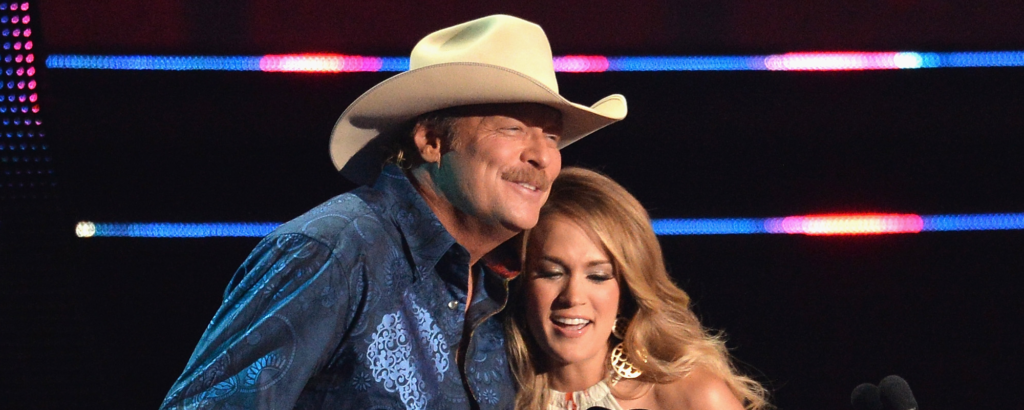
There is also something quietly poetic about Carrie Underwood being part of this moment. Her presence reflects how influence travels—not in loud declarations, but in subtle inspiration carried across years. The artists who once listened become the ones who now stand beside the very people who shaped them.
As the night approaches, anticipation builds not only for performances but for what the event represents. It is a reminder that country music is not just an industry of hits and charts, but a lineage of voices passing responsibility from one era to the next. Alan Jackson’s farewell is not an ending in the traditional sense—it is a handoff.
When Carrie Underwood takes the stage that night, it will be more than a performance. It will be a moment of acknowledgment between two eras, a bridge built through music, respect, and shared understanding of what country music truly stands for. And in that silence between applause and song, the meaning of the night will speak louder than anything else ever could.