
As the finale of American Idol approaches, attention is steadily shifting toward one of its most quietly compelling contestants, Hannah Harper. While much of the season has been filled with standout performances and dramatic eliminations, Hannah’s journey has unfolded in a more subtle, almost understated way—one that fans are only now beginning to fully appreciate.
At first glance, her progress might have seemed steady rather than explosive. She wasn’t always the loudest presence on stage or the most viral moment on social media. But those who followed closely began to notice something different: a slow, consistent build in confidence, tone, and emotional control. That gradual evolution is now becoming the focal point of conversation as viewers revisit her earlier performances with new perspective.

Fans are pointing out a detail that was easy to overlook in the beginning of the season. Early on, Hannah often appeared slightly reserved during introductions and pre-performance moments, but her delivery on stage told a different story. With each passing week, that contrast began to fade. The hesitation disappeared, replaced by a calm assurance that suggested she was growing more comfortable not just with the competition, but with herself as an artist.
What makes this detail so compelling is how naturally it unfolded. There was no sudden transformation or dramatic reinvention. Instead, Hannah’s journey reflects something more realistic: gradual refinement under pressure. Supporters say this quiet consistency is exactly what has helped her build a strong emotional connection with the audience over time, even without dominating every headline moment.
As the competition intensified, so did her performances. Songs that once felt technically careful began to carry more emotional weight. Viewers started noticing how she interpreted lyrics differently, adding subtle phrasing choices and controlled vulnerability that gave her performances a more personal feel. This shift didn’t happen overnight—it developed gradually, almost imperceptibly, until it became impossible to ignore.
Social media discussions have played a major role in bringing this evolution into focus. Fans have begun revisiting earlier clips, comparing them to her most recent performances, and pointing out how much she has matured vocally and emotionally. Many are surprised at how much they missed the first time around, admitting that her growth becomes clearer only when viewed as a complete journey rather than isolated performances.
There is also growing conversation about her connection with the audience. Unlike contestants who rely heavily on big theatrical moments, Hannah’s appeal seems rooted in authenticity. Viewers describe her as someone who doesn’t perform at them, but rather sings with them—creating a sense of shared emotional space that feels increasingly rare in high-pressure talent competitions.
That connection has become even more visible as the finale approaches. Each performance now carries additional weight, not just in terms of competition stakes, but in how fans interpret her overall story. Supporters argue that her journey represents something deeper than weekly rankings—it reflects patience, resilience, and the ability to steadily grow under public scrutiny.
Industry observers also note that contestants like Hannah often benefit from late-season recognition. While early frontrunners tend to attract immediate attention, quieter competitors who show consistent development often build stronger long-term support. In Hannah’s case, that pattern appears to be unfolding in real time, as more viewers reassess her trajectory heading into the final stages.
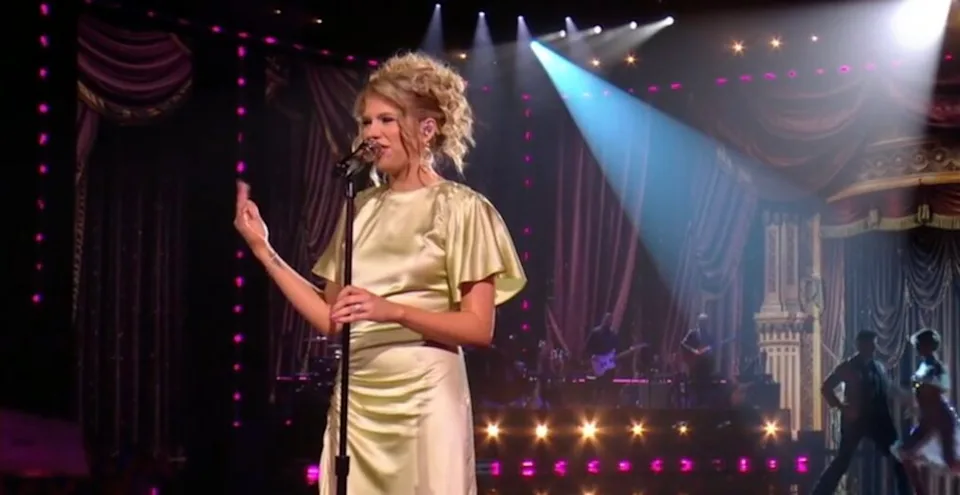
The emotional tone of her journey is also becoming a key talking point. There is a sense among fans that her story is not defined by a single breakout moment, but by a series of small, meaningful improvements. These incremental changes—better control, deeper emotional delivery, stronger stage presence—have collectively shaped her identity in the competition.
As anticipation builds, conversations across social platforms continue to grow. Hashtags related to her performances are circulating more frequently, and fan debates about her chances in the finale are becoming increasingly passionate. Yet even amid predictions and rankings, many supporters seem focused less on outcome and more on appreciation of how far she has come.
With the final performances ahead, one question lingers in the air. If this level of growth has already gone unnoticed by many until now, what final transformation might still be waiting to be revealed when it matters most?