Some songs entertain. Others leave a permanent mark on the people who write them. “Over You” belongs to the second kind.

Long before Blake Shelton became one of country music’s biggest stars, he experienced a loss that changed his life forever. At just 14 years old, he lost his older brother, Richie, in a tragic car accident.
Grief settled quietly into Blake’s life. Rather than talking about it publicly or turning it into music, he carried the pain privately for years, protecting memories that were simply too painful to revisit.
Everything changed during an ordinary evening on a tour bus. Blake and Miranda Lambert happened to watch a television program featuring his family, where his father spoke a simple but unforgettable truth: you never truly get over losing someone—you only learn to live with it.
Those words unlocked emotions Blake had kept buried for decades. For the first time, he shared the depth of his heartbreak with Miranda, who gently asked a question that would change both of their careers: “Have you ever written about him?”
The answer was no. But together, they decided to try.
What followed wasn’t just another songwriting session. It became an emotional release. Tears flowed as memories surfaced, and one lyric captured a feeling that many people rarely admit after losing someone—the anger that comes with unimaginable grief.

One memory proved especially heartbreaking. After Richie’s passing, Blake inherited recordings of his brother singing. Listening to those tapes became a way of holding on, and that deeply personal detail found its way into the song, giving it an authenticity few songs ever achieve.
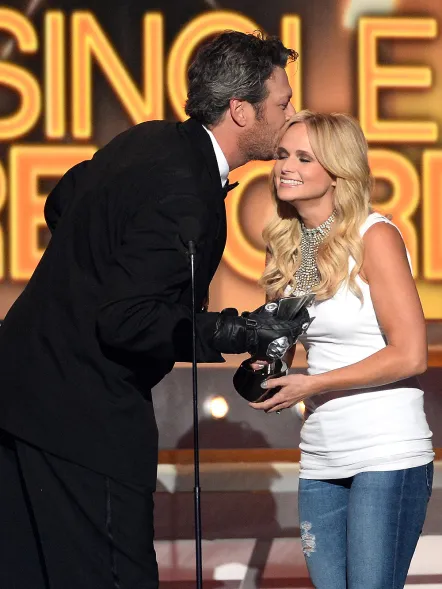
When the writing was finished, Blake realized he couldn’t perform it night after night. The emotions were simply too overwhelming. Miranda stepped forward to record “Over You,” transforming their shared heartbreak into a song that resonated with millions.
The gamble became a triumph. “Over You” climbed to the top of the charts, remained there for weeks, and earned Song of the Year honors from both the CMA and ACM Awards. More importantly, it became something far greater than a hit record. It became proof that even the deepest pain can be transformed into something that comforts others—and that sometimes the most unforgettable songs are the ones written through tears instead of triumph.