
Ella Langley delivered a defining moment during the CMA Fest broadcast with her performances of “Be Her” and “Choosin’ Texas,” reinforcing her growing position in modern country music. What stood out was not just the vocal execution, but the control and emotional architecture she brought to both songs, turning a televised set into something that felt immediate and personal.
“Be Her” carried a restrained intensity, built on phrasing that leaned into vulnerability without losing strength. Instead of over-singing, she allowed space between lines, letting the narrative of the song settle before pushing forward. That restraint gave the performance weight, making the lyrical tension feel lived-in rather than performed for effect.
When she transitioned into “Choosin’ Texas,” the energy shifted decisively. The arrangement opened up, and her vocal tone followed suit—more assertive, more grounded, and rhythmically confident. The contrast between the two songs highlighted her range, not just in voice, but in interpretive intent, showing an artist who understands how to modulate emotional tone across different sonic environments.
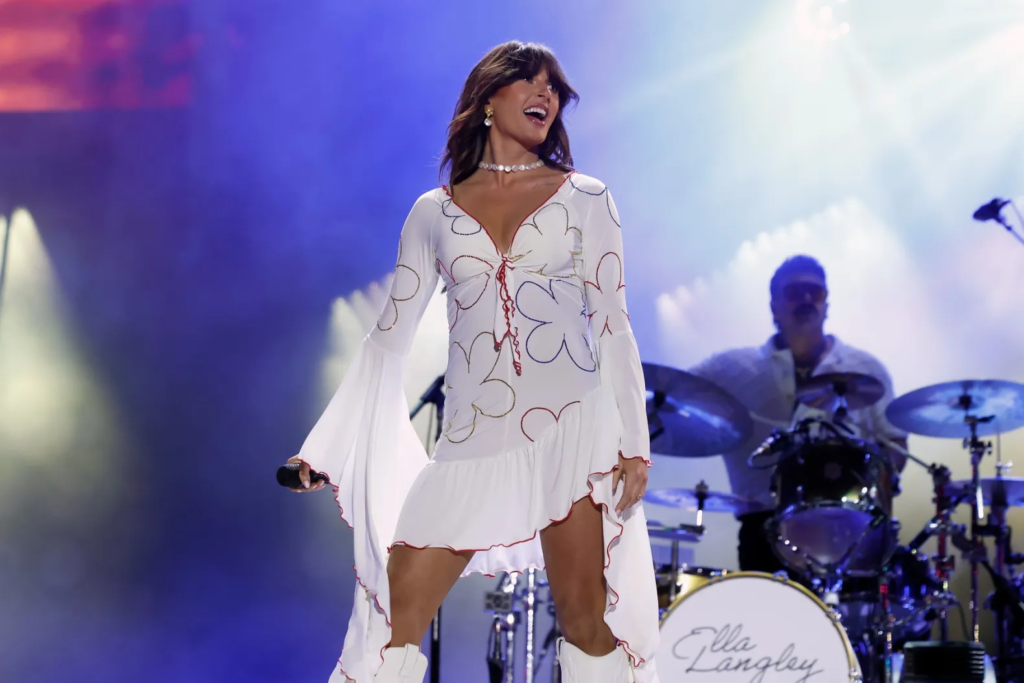
Part of what made the CMA Fest appearance notable was the clarity of artistic identity. In an era where country-pop crossovers can blur individuality, her delivery maintained a distinct Southern storytelling edge. She didn’t chase spectacle; instead, she anchored the performance in narrative clarity, which is often what separates emerging artists from long-term mainstays.
The broadcast setting also amplified the importance of stage presence. Without the intimacy of a small venue, artists must translate emotion through camera framing and controlled physical expression. Her posture, timing, and subtle shifts in expression carried as much meaning as the vocals themselves, allowing the performances to resonate even through a screen.
Audience reception reflected that impact. Clips circulated rapidly across social platforms, with viewers pointing to the authenticity of her delivery and the conviction behind her phrasing. That organic response is often a stronger indicator of cultural traction than traditional metrics, especially in the country genre where storytelling credibility matters deeply.
Musically, both songs benefited from a tight arrangement approach. Nothing felt overproduced or distracting. Instead, the instrumentation served as a frame rather than a centerpiece, leaving space for lyrical emphasis. This production choice aligned well with her vocal strengths, which rely on tone control and narrative pacing rather than sheer vocal power alone.
What is becoming increasingly evident in her trajectory is a balance between commercial accessibility and artistic specificity. She is not confined to a single emotional register, and that flexibility allows her to navigate between radio-ready energy and introspective songwriting without losing coherence as an artist.
From a broader industry perspective, performances like this often function as inflection points. CMA Fest has historically been a platform where emerging acts transition into mainstream recognition. Her set fits that pattern, not because it relied on novelty, but because it demonstrated consistency under high visibility conditions.

There is also a strategic element in song selection. Choosing “Be Her” and “Choosin’ Texas” created a deliberate contrast that showcased dual facets of her artistry: introspective storytelling and assertive regional identity. That duality is central to building a sustainable catalog in country music, where relatability and persona often intersect.
Ultimately, the performance reinforced a clear trajectory. Rather than presenting a single breakout moment, it suggested accumulation—of skill, audience trust, and artistic direction. CMA Fest did not redefine her identity; it clarified it for a wider audience, positioning her as an artist operating with intent rather than momentum alone.