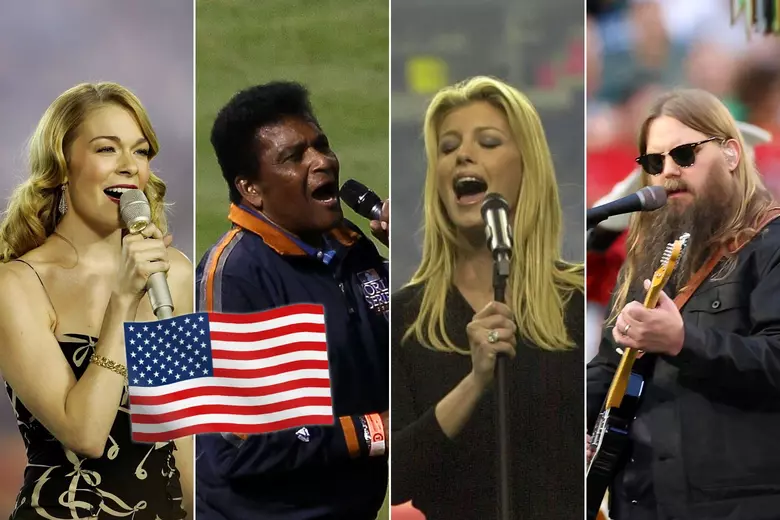
Country music has quietly, and then unmistakably, taken ownership of one of the most sacred moments in American performance culture—the national anthem. What was once a tradition reserved for orchestras, choirs, and ceremonial voices has increasingly become a stage where country artists are now delivering some of the most talked-about renditions in modern history. Across three massive global platforms, the genre has not just participated—it has defined the moment.
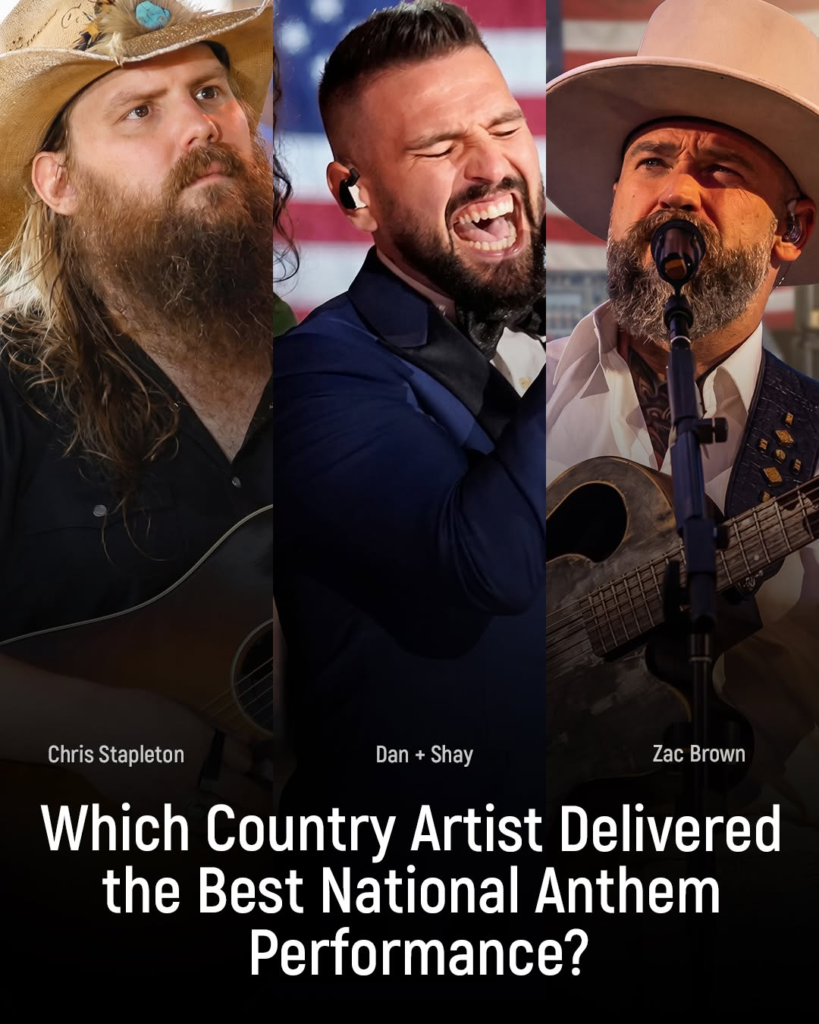
At Super Bowl LVII, Chris Stapleton delivered a performance that stripped everything down to its emotional core. Standing alone with a guitar, he offered no production, no visual spectacle, and no distraction. What remained was pure voice and vulnerability. In a stadium built for spectacle, the silence between his notes felt just as powerful as the sound itself. It became one of those rare Super Bowl moments that fans revisit not for entertainment, but for impact.
There is something about simplicity that magnifies emotion. Stapleton’s rendition reminded audiences that the national anthem does not need embellishment to feel powerful. It needs truth. And in that moment, his performance became less about music and more about connection—between artist, audience, and the meaning behind the song itself.
Then came a different kind of moment on a completely different stage. Dan + Shay opened the 2026 FIFA World Cup with a rendition that spread across the internet at incredible speed, surpassing 700,000 views in just three hours. The global reach of the World Cup already guarantees attention, but this performance added another layer—country music stepping onto the world’s biggest sporting stage and being met with instant global response.
Fox Sports captured the sentiment with a simple observation: “The Star-Spangled Banner hits different on home soil.” Yet the performance resonated far beyond geography. It was not just about where it was sung, but who was chosen to sing it. Country music, rooted in American storytelling, was now representing the United States in front of a worldwide audience watching from every corner of the globe.
That contrast between intimacy and scale is what makes these moments so compelling. A genre often associated with personal storytelling suddenly becomes the voice of international ceremony. It is no longer confined to radio charts or award shows—it becomes part of global broadcast history.
The third defining moment came in a setting few could have predicted. Zac Brown stood on the White House South Lawn alongside the United States Marine Band and performed the national anthem for 8,000 active service members during UFC Freedom 250. The event itself marked the first major sporting competition ever held at the White House, instantly placing it in a category of its own.
Unlike stadium performances or global broadcasts, this moment carried a different kind of weight. It was not just entertainment—it was presence. The combination of military tradition, political symbolism, and live sport created an atmosphere where the anthem felt deeply tied to the setting itself. Zac Brown’s performance became part of a larger historical snapshot, one that blended ceremony and culture in real time.
What connects these three performances is not just the artists, but the scale of their stages. Super Bowl LVII, the FIFA World Cup, and UFC Freedom 250 at the White House represent three different pillars of global attention: national spectacle, international competition, and historic political space. Each one carries its own expectations, its own audience, and its own pressure.
Yet in all three cases, country music was chosen. That choice is significant. It reflects a growing recognition that the genre carries a certain emotional clarity—an ability to ground even the largest moments in something human and familiar. Whether it is a stadium of 70,000 or a global broadcast reaching millions, the voice remains central.
There is also a deeper conversation emerging from these moments about identity and representation. The national anthem is not just a song—it is a ritual. And who performs it often shapes how that ritual is experienced. Country artists, with their roots in storytelling and tradition, bring a particular tone that aligns with themes of history, pride, and reflection.
As debates continue over which performance stands above the others, the comparison itself reveals something important. It is no longer surprising that country music is trusted with these moments. Instead, the question has shifted toward how each artist interprets them differently—through restraint, scale, or symbolism.
Chris Stapleton brought isolation and purity. Dan + Shay brought global immediacy. Zac Brown brought historical presence. Three interpretations. Three different emotional languages. One shared anthem.
In the end, the conversation may not be about choosing a single winner. It may be about recognizing a broader shift happening in real time. Country music is no longer simply performing on big stages. It is being invited to define them. And as future events unfold on even larger platforms, one question continues to linger—how much bigger can these moments get, and who will be chosen to sing when the world is listening next?