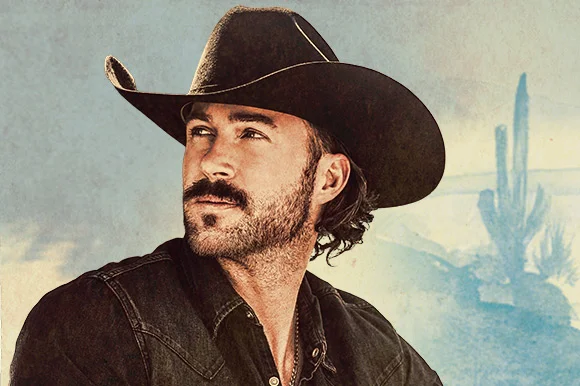
CMA Fest has always been known for surprises, but Night 4 at Nissan Stadium delivered a moment that felt like country music collided directly with Hollywood in real time. Riley Green stepped onto the stage as host, guiding the energy of a packed stadium, but what began as a standard festival moment quickly shifted into something far more unpredictable. With 60,000 fans watching, he teased a special filming opportunity—and the crowd had no idea what was coming next.
The atmosphere changed the second Glen Powell walked out. The reaction was instant, loud, and almost disbelieving. A Hollywood leading man stepping into the heart of CMA Fest already felt unexpected, but the purpose behind his appearance made it even more intriguing. Powell was in Nashville filming The Comeback King, a country music dramedy directed by Judd Apatow, set for release on February 5, 2027.
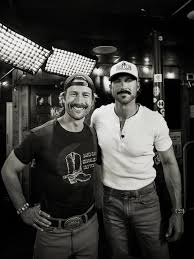
In the film, Powell plays a country star navigating the slow decline of his career, a storyline that mirrors the emotional highs and lows often found in real country music narratives. But on this night, fiction and reality blended in a way no script could fully capture. Riley Green didn’t just introduce him to the crowd—he invited the entire stadium to become part of the scene.
What followed turned Nissan Stadium into the largest film set many fans had ever witnessed. Powell addressed the crowd directly, encouraging them to participate as extras in the moment. The energy shifted again as thousands of voices echoed through the stadium, chanting “King!” in unison. It was less like a concert interruption and more like a shared performance between artist, actor, and audience.
Then came the moment that instantly defined the night. In true over-the-top fashion, Powell poured beer into a cowboy boot, raised it to the roaring crowd, and performed a “shoey” on stage. The act, equal parts theatrical and chaotic, sent the stadium into an even louder frenzy. Without hesitation, he tossed the boot into the crowd, turning an already surreal scene into something fans would be talking about long after the final note of CMA Fest faded.
But amid the spectacle, Powell brought the moment back to its emotional core. Speaking directly to the audience, he said, “This movie is for you guys. This is for the fans of country music.” That single line reframed everything that had just happened. It was no longer just a promotional stunt or viral moment—it became a tribute to the culture that inspired the film itself.
Riley Green’s role in the moment also carried its own weight. Known for his authentic connection to traditional country storytelling and for bridging modern popularity with classic influences, he served as the perfect host for such an unexpected crossover. His presence helped ground the chaos, giving structure to what could have otherwise felt like pure improvisation.
The contrast between Riley Green and Glen Powell added to the uniqueness of the night. One represents the rising strength of modern country authenticity, while the other brings Hollywood storytelling into Nashville’s most iconic festival. Together, they created a moment that blurred the line between entertainment industries that rarely collide in such a direct and physical way.
As the crowd settled after the frenzy, there was a shared sense that something unusual had just taken place. CMA Fest is known for collaborations, surprise guests, and once-in-a-lifetime performances, but this moment felt different. It wasn’t just a musical performance or a cameo appearance—it was participatory storytelling on a massive scale.
For fans, the experience wasn’t something observed from a distance. It was something they were part of. Every chant, every reaction, and every cheer became part of a scene that will now live both in film and memory. That dual existence gives the moment a rare kind of permanence.
From a broader perspective, the crossover between country music and Hollywood continues to grow, but rarely does it unfold in such an organic and unfiltered way. This was not a carefully staged red-carpet introduction or a controlled promotional appearance. It was spontaneous, loud, and fully immersed in the energy of live performance.
The decision to involve the entire stadium as extras also speaks to a growing trend in entertainment—audiences are no longer just spectators. They are participants in experiences that blur the boundaries between performance and reality. In that sense, CMA Fest Night 4 may be remembered as a defining example of that shift.
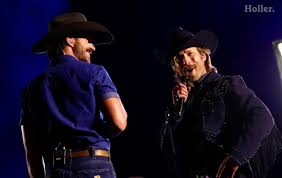
As The Comeback King moves toward its 2027 release, this moment will likely become part of its mythology. Fans who were present will remember not just the film or the actors involved, but the feeling of being inside the story before it even reached theaters.
By the end of the night, CMA Fest 2026 had delivered one of its most unexpected highlights. Riley Green and Glen Powell turned a music festival into a living film set, merging two worlds that rarely overlap so completely. And as the crowd slowly dispersed from Nissan Stadium, one thing was clear—the line between country music and Hollywood had just been redrawn.